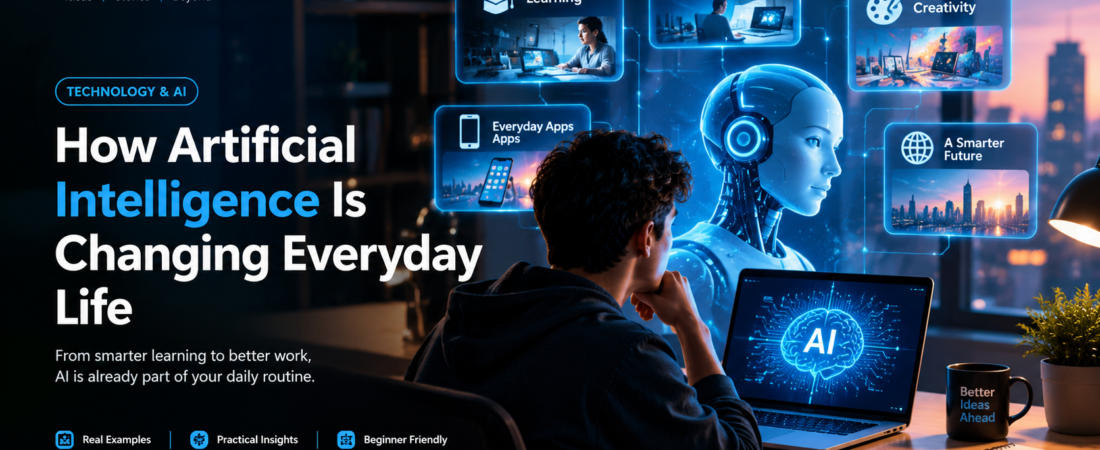
Artificial intelligence is not a single machine or capability. It is a broad group of technologies designed to perform tasks that often involve recognizing patterns, making predictions, generating content, or responding to instructions. Some systems analyze large volumes of data to estimate what may happen next; others identify objects in images, convert speech into text, or produce written and visual material from prompts. Their methods and abilities vary, so the term “AI” describes a family of tools rather than one uniform kind of intelligence.
For many people, these technologies have become part of ordinary routines, often without attracting much notice. Voice assistants answer questions and set reminders, recommendation feeds suggest music or videos, and navigation apps use changing traffic information to propose routes. Spam filters sort incoming messages, while customer-service tools can answer common questions or direct people to relevant support. Such features show how AI has moved beyond research laboratories and specialist workplaces into the digital services people use each day.
This article considers practical applications across education, work, creativity, and routine tasks, alongside the changes and questions that accompany them. AI tools may help explain a difficult topic, summarize information, draft material, or automate repetitive steps, but their usefulness depends on how they are designed and applied. They can make errors, reflect patterns or biases in their data, and produce confident-sounding responses that still require checking. AI is best understood as a tool shaped by human decisions, including choices about its goals, training, access, and oversight. It does not understand the world in precisely the way people do: generating a plausible answer is not the same as possessing human experience, judgment, or awareness. Recognizing both the practical value and the limits of these systems helps people use them thoughtfully, rather than treating them as either mysterious minds or automatic solutions to every problem.
Many everyday AI tools rely on machine learning: a way for computer systems to identify patterns in examples rather than follow only a fixed list of rules. During training, a model processes large collections of data, such as text, images, or recorded speech. It adjusts its internal settings to capture statistical relationships in those examples. A model trained on language, for instance, may learn which words and phrases commonly appear together. This process does not mean the system understands information in the same way a person does; it learns patterns that can help it make predictions.
Generative AI uses learned patterns to create new material. When someone enters a prompt, a language model predicts a likely sequence of words, while an image generator may produce visual details step by step. Other systems can create or transform audio, summarize information, or help draft code. The output is generated in response to the input and the model’s training, rather than simply retrieved as a single stored answer. The wording of a prompt and any additional instructions can therefore influence what the system produces.
This differs from a search engine, which primarily helps locate and rank existing webpages or other indexed sources. Some AI products combine search with generation, but a generated response is not automatically a verified report of facts. Because models are designed to produce plausible patterns, an answer can sound fluent and confident while being inaccurate, incomplete, or invented. The quality of the result depends partly on the data used for training, the clarity of instructions, and whether the tool suits the task. Human review remains important, especially when decisions carry consequences. Checking claims against reliable sources and considering the system’s intended purpose helps people use AI outputs more carefully.
Artificial intelligence is becoming a practical part of education, helping students practise skills and giving teachers additional ways to support learning. Adaptive learning platforms can adjust the difficulty or pace of exercises according to a student’s responses. For example, if a learner repeatedly struggles with fractions, a math program might offer simpler explanations and extra practice before moving on. Students who grasp a topic quickly can progress without waiting for the whole class. This flexibility can make practice feel more relevant, while automated feedback can identify errors and provide a prompt response rather than leaving students unsure until the next lesson.
AI tools also extend learning beyond conventional exercises. A language-learning application can simulate a conversation in another language, allowing a learner to practise ordering food or asking for directions and receive suggestions about vocabulary or grammar. Tutoring chatbots can answer questions and guide students through a problem step by step, although they work best as supplements to instruction. Accessibility features, including speech-to-text, text-to-speech, and automated captions, can help students engage with material in ways that suit their needs. Teachers may use AI to draft lesson ideas, create practice questions, or adapt reading passages, then review and revise the materials for their classes.
These benefits depend on careful use. AI systems can give incorrect explanations with confidence, so students should check important information and ask teachers when an answer is unclear. Access to reliable devices and internet service is uneven, and systems may reflect biases in their data or design. Schools and families must also consider how student information is collected, stored, and shared. If learners rely on generated answers instead of working through challenges, they may miss opportunities to develop understanding and persistence. Likewise, technology cannot replace the trust, encouragement, and judgment of a teacher. Clear rules should explain when AI assistance is appropriate, how students should acknowledge it, and which tasks require independent work. Used transparently and with adult guidance, AI can widen access to practice and feedback while keeping human relationships and student effort central to learning.
Artificial intelligence is becoming part of routine workplace activity, often by helping employees handle information more quickly. A writing tool can turn a rough outline into a first draft, while a summarization system can condense a long report into key points for review. After a meeting, an employee might provide notes to an AI assistant and ask it to produce an action list, then check names, deadlines, and commitments before sharing it. Translation tools can help teams understand correspondence across languages, and workplace assistants can answer common questions about policies or procedures.
AI can also support tasks that involve analysis and technical work. A system may sort customer feedback into themes, identify patterns in a spreadsheet, or help an analyst prepare a chart. Coding assistants can suggest explanations or draft sections of routine code, which developers still need to test and maintain. Customer service teams may use automated tools to suggest responses or resolve straightforward requests, leaving staff more time for complex cases. These applications can reduce repetitive work and help people move faster, but their usefulness depends on the quality of the information supplied and the accuracy of the output.
Workplace adoption also creates risks that require active management. AI-generated material can contain errors, omit important context, or present uncertain claims as facts. Entering sensitive business, employee, or customer information into an unapproved tool may expose confidential data. Systems trained on biased information can reproduce unfair patterns, while automation may shift responsibilities or alter the skills a role requires. Employers should provide practical training, set clear rules for approved use, and ensure that workers review outputs before relying on them. Human accountability is especially important when recommendations affect hiring, health, finances, or people’s rights. In these settings, AI may assist with analysis, but qualified people should examine the evidence, explain decisions, and remain responsible for outcomes.
Generative AI is becoming a flexible addition to everyday creative work, helping people move from a blank page to a set of possibilities. A small business owner might ask an image tool for several mood-board concepts for a new café, then compare color palettes and visual styles before hiring a designer. A writer can request alternative headlines for an article, while a musician might use a generative tool to explore rhythms or chord progressions. In video production, AI can help draft a rough storyboard or suggest shots that a director and artist later revise. These uses can make experimentation faster and lower the effort needed to develop an initial idea.
The most productive approach is often to treat AI output as a starting point or collaborator, not as finished work. A generated storyboard may clarify pacing, but a human creator still needs to assess whether its scenes make sense, fit the intended audience, and serve the project’s purpose. Similarly, suggested copy may provide useful options but require fact-checking, editing, and a distinctive point of view. Human judgment brings context, taste, accountability, and lived experience that automated systems may not reliably provide. Reviewing and reshaping results also helps ensure that the final work reflects the creator’s intent rather than simply repeating a tool’s first response.
Creative uses of AI raise important questions about originality, attribution, consent, and the sources used to train models. Creators may want to know whether training data included copyrighted work or material shared without permission, while clients and audiences may expect clarity about how an image, song, or text was made. Copyright rules differ by jurisdiction and continue to evolve, so users should check relevant laws, platform terms, and organizational policies before publishing or selling AI-assisted work. Disclosure may be appropriate, particularly when audiences could reasonably assume that a human made the work unaided. There are also economic concerns: automation can reduce demand for some tasks or change rates and workflows for creative professionals. Using these tools responsibly means weighing convenience against those effects and involving human creators where their expertise is needed.
Artificial intelligence often appears not as a dramatic new technology but as quiet assistance woven into routine choices. A map app may notice a traffic jam and recommend a different route before a driver reaches it. Predictive text suggests a word while someone writes a message, and photo libraries group images by faces, places, or objects to make them easier to find. Online shops and streaming services use past activity to suggest products, films, or music. These features can save time by sorting information and anticipating likely needs, often with little effort from the user.
Other everyday examples operate in the background. A phone may filter suspicious messages, while a bank system flags a purchase that differs from a customer’s usual pattern. Smart-home devices can adjust lighting or heating in response to schedules, sensors, or spoken requests. Voice assistants interpret commands to set timers, play music, or check the weather. In each case, software processes signals and produces a prediction or response; the result may feel immediate, even though it relies on data and automated classification. When accurate, these tools can make ordinary tasks faster and more convenient.
Convenience does not make every result reliable or neutral. Recommendation systems tend to reflect earlier clicks and purchases, potentially narrowing the range of options people encounter. A message filter may mislabel a legitimate note as spam, and a fraud alert can interrupt an ordinary transaction. Connected speakers, cameras, and other devices may collect sensitive information, depending on their settings and how their data is stored or shared. Users can review privacy controls, limit permissions, and check how long activity is retained. It is also useful to compare suggestions with other sources rather than assuming a personalized recommendation is objective or the best available choice. Treating AI as assistance—not authority—helps people benefit from useful features while retaining control over everyday decisions.
Artificial intelligence can make routine tasks faster, but convenient results are not necessarily accurate ones. Generative systems may present invented details, citations, or explanations in fluent, confident language, making errors difficult to recognize without independent checks. Other AI tools can also misclassify information or make recommendations based on incomplete inputs. The risk is especially important when people treat a polished answer as verified evidence rather than as a starting point for review.
AI systems learn patterns from data, and those data may omit some groups, contain historical inequalities, or represent communities unevenly. As a result, performance can vary across languages, dialects, locations, and populations. Systems may also struggle with context, ambiguity, rapidly changing facts, or unusual situations that differ from the examples they encountered during development. A tool that performs well in common cases may still produce unreliable outcomes at the edges, where careful human assessment is often most necessary.
Privacy and security require attention as well. Information entered into an AI service may include personal details, confidential work material, or sensitive records; how it is stored and used depends on the service and its settings. Users should follow organizational rules and avoid sharing data they are not authorized to disclose. There may also be risks from insecure integrations, unauthorized access, or misleading outputs that encourage unsafe actions. Human oversight remains essential: excessive reliance can weaken independent judgment, obscure responsibility, and allow mistakes to pass unchecked. Capabilities differ substantially by tool, version, and task, so results should be evaluated in the setting where they will be used. Success at drafting, sorting, or summarizing does not establish competence in medical, legal, financial, hiring, or other consequential decisions. For high-stakes choices, AI can sometimes support qualified professionals, but it should not replace appropriate expertise, verification, and accountability. Users should consider the consequences of an error, check important claims against reliable sources, and retain a clear route for human review. These limits do not make AI unusable; they define the care needed to use it responsibly.
AI tools can be useful for brainstorming, summarizing, drafting, or explaining unfamiliar topics, but their responses are best treated as suggestions rather than finished work. Read the output critically, check whether it addresses the actual question, and revise it to reflect your own purpose and knowledge. A fluent answer is not necessarily an accurate one. For important claims, consult reliable sources such as official guidance, primary documents, reputable research, or qualified professionals. Follow cited links where possible: references may be incomplete, irrelevant, or fabricated, and a confident tone does not prove that information is true.
Protect privacy by considering what information a tool receives and how the service may store or use it. Avoid entering passwords, financial details, personal records, confidential business material, or identifying information unless the tool has been explicitly approved for that purpose. When uncertain, remove names and other details that could identify people, or use an authorized alternative. It is also worth asking what a system can and cannot do. It may generate plausible language without understanding context, have outdated information, or perform poorly on particular tasks. Knowing these limits helps you decide when human expertise or a different source is needed.
Before relying on an answer, look for bias, missing perspectives, unsupported assumptions, and important context that may have been left out. Compare consequential claims against more than one dependable source, especially when the topic concerns health, money, legal matters, safety, or someone’s rights. Keep a person accountable for decisions that significantly affect people; AI may assist with analysis, but responsibility should not be handed over to an automated system. Students and workers should also follow school, university, and employer policies, and disclose AI assistance when rules or professional expectations require it. These habits make room for useful support while preserving privacy, independent judgment, and clear accountability.
Artificial intelligence is already part of everyday life, often through tools people use without thinking of them as AI. It can help learners explore ideas, support workers with routine tasks, offer new options for creative practice, and make ordinary activities faster or more convenient. These changes are not simply the result of the technology itself. Their effects depend on how systems are designed, which people can access them, and the choices made by organizations and individuals using them.
AI is likely to become more deeply integrated into familiar software, services, and devices. As that happens, public discussion will continue around questions that cannot be settled by technical performance alone. Systems may reproduce unfair patterns, access to useful tools may remain uneven, and automation may reshape jobs and required skills. The collection and use of personal information also demand careful attention. Clear accountability matters when AI contributes to decisions that affect people, especially when errors are difficult to identify or challenge.
These concerns do not erase the practical benefits. Used thoughtfully, AI can save time, help people work through information, and expand what individuals and teams are able to accomplish. But convenience should not be confused with reliability, and a fluent answer is not necessarily a sound one. People still need to assess evidence, protect sensitive information, and take responsibility for consequential choices. In conclusion, the most useful future for everyday AI is a human-centered one: technology should support people’s goals and expertise, while leaving careful thinking, judgment, and responsibility firmly in human hands.